
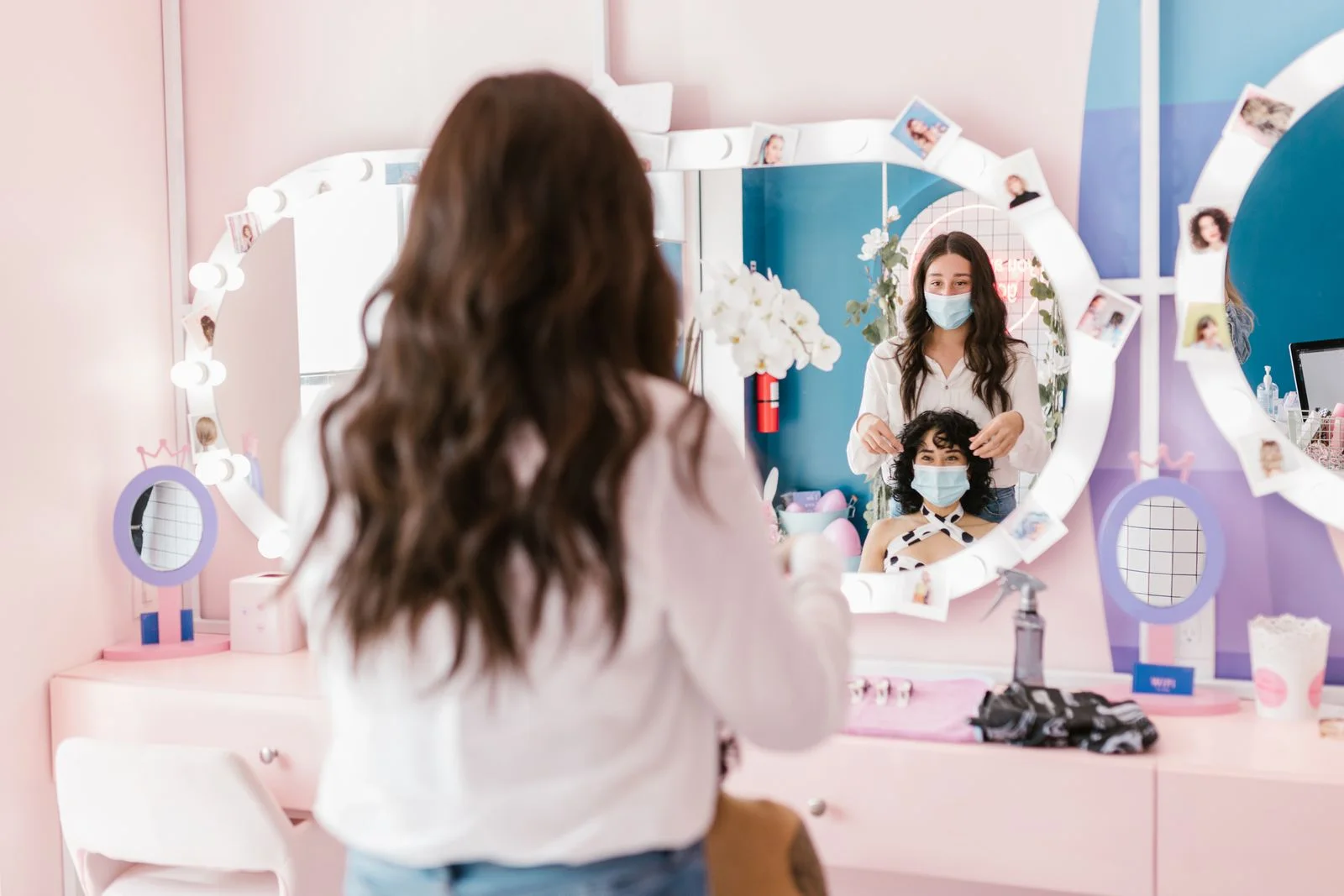
A men's or women's cut in Korea isn't priced off one laminated menu the way it might be at home — the identical cut can cost two or three times more depending entirely on whose chair you sit in, and a perm requested by its English name might do the opposite of what that name suggests.
What to bring: reference photos and your chemical history
Bring three or four reference photos, not one — front, side, and back angles, since a single cropped front-on shot hides how much length actually comes off in the back. A photo pulled from a search engine of a model with different hair density than yours is a starting point for a conversation, not a guarantee of an identical result.
Write down or have ready your recent chemical history: the date of your last color, perm, or bleach, since a service layered over already-processed hair carries different risks than the same service on virgin hair, and a stylist needs that timeline to plan safely. A basic vocabulary list, or a translation app pulled up and ready before you sit down, saves time once the consultation starts — describing length and layering precisely in a second language, live, under time pressure, is harder than it sounds.
Booking: phone, app, or walk-in, and how to confirm English support
Phone calls, dedicated salon booking apps, and straightforward walk-in slots are all common depending on the salon, and which one works best varies by neighborhood and how busy that particular salon runs. Ask specifically whether an English-speaking stylist is on shift for the time you want, rather than assuming a salon in a tourist-heavy area has one on every shift — that assumption doesn't hold reliably even in neighborhoods full of foreign visitors.
Popular designers and weekend slots can book out several days ahead, sometimes longer for a specific senior stylist with a strong following. If your schedule is flexible, a weekday morning slot is generally the easiest to get on short notice.
How pricing actually breaks down: designer grade and length surcharges
Korean salons price by designer grade rather than a single salon-wide rate for a given service — junior designers sit at the bottom of the scale, with intermediate, senior, and director-level designers (원장급) priced progressively higher for the identical haircut or chemical service. A senior or director-level designer can run two to three times a junior designer's rate for the same cut, and that gap reflects who's holding the scissors, not a different service being performed.
On top of the base price, longer hair typically adds a surcharge, since more product, more processing time, and more physical hair are involved in a color or perm service. As of July 2026, a junior-designer cut in Seoul commonly runs somewhere around ₩25,000 to ₩45,000, while a senior or director-level cut can run ₩70,000 to ₩150,000 or more; perms and full color services often fall in the ₩90,000 to ₩250,000 range before any length surcharge is added. Confirm the current rate and designer grade together when you book — a quoted price with no stated grade attached isn't a complete quote.
How long each service actually takes
A cut alone is the shortest appointment on a salon's menu, often finishing within an hour depending on hair length and how much consultation time it involves. Perm and color services run considerably longer — commonly two hours or more each on their own — because both involve processing time where chemicals sit on the hair before rinsing.
A perm and color booked back-to-back in the same visit can run three to five hours total, long enough that visitors sometimes underestimate it and try to stack another appointment or activity the same afternoon. A 클리닉 (hair clinic) treatment add-on, covered further down, adds further time on top of whatever main service it's paired with.
What common Korean salon service names actually mean
볼륨매직 (volume magic) is a straightening technique that also builds root volume — despite "magic" in the name, it's a chemical straightening service, not a styling trick done with a brush and dryer. 다운펌 (down-perm) loosens or relaxes existing curl and volume rather than adding curl, which runs close to the opposite of what the English word "perm" suggests to someone hearing it for the first time. 레이어드펌 (layered perm) is a perm technique applied to already layer-cut hair, meant to add movement and shape to those layers — it's a chemical service layered onto a cut you'd need separately, not a haircut itself.
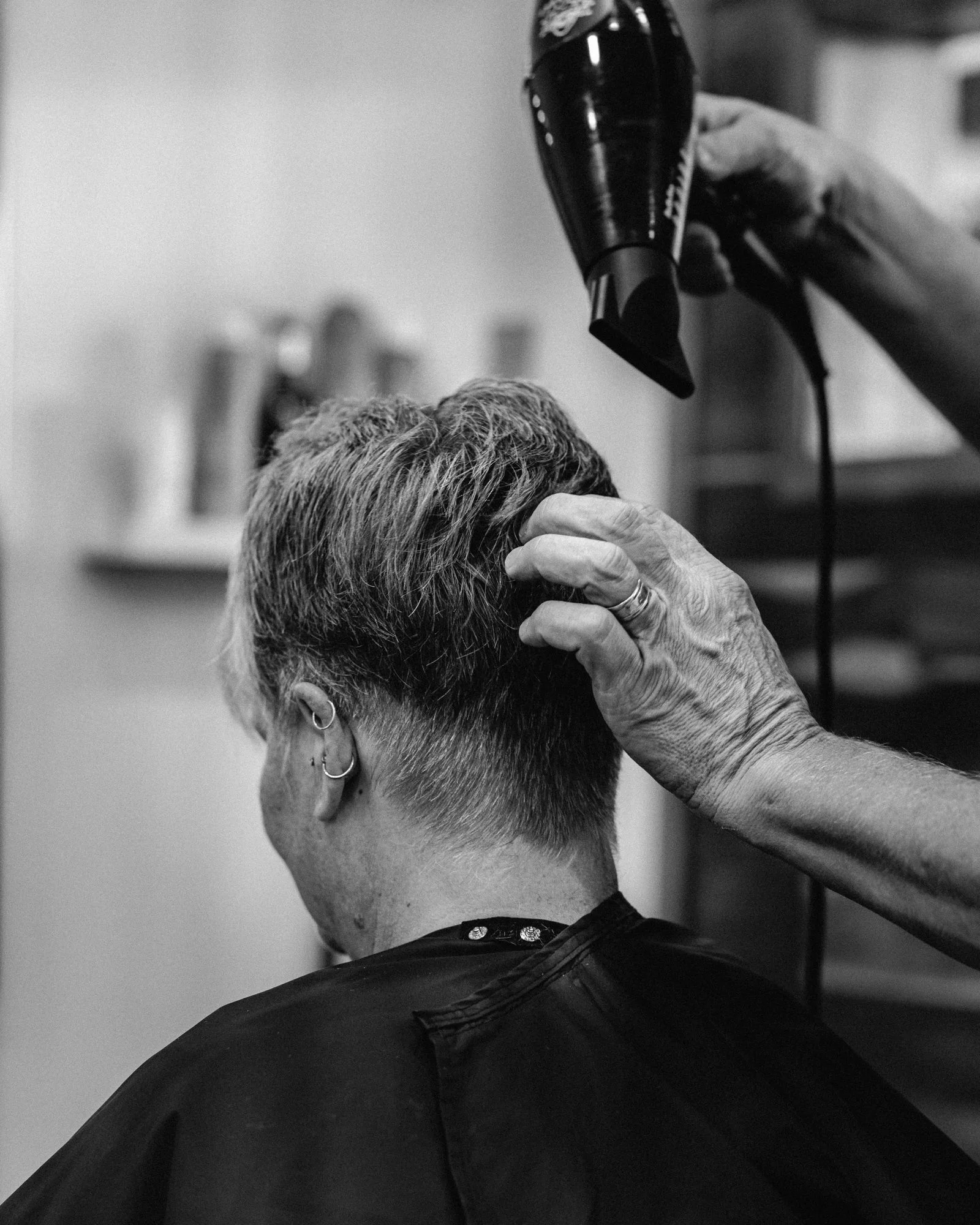
Mixing these up at the counter is an easy way to end up with a result that's the reverse of what you pictured. Asking a stylist to translate the specific Korean service name back into a plain description of what it does to your hair, before agreeing to it, closes that gap.
Saying up front that your hair type is different
State your hair's thickness, curl pattern, and any texture differences from what a stylist typically works with before the service starts, rather than partway through. Techniques, processing times, and product choices are often calibrated around the hair types a salon sees most often, so flagging a real difference upfront gives the stylist a chance to adjust rather than guess mid-service.
This is a heads-up, not a guarantee that the exact result in your reference photo will be reproduced — a technique tuned for finer, straighter hair can process at a different speed and land differently on hair that's thicker, coarser, or more tightly curled than what the salon typically sees.
Where visitors get stuck: length, mid-service upsells, and the fringe decision
Relative length words like "a little" or "a lot" get interpreted differently person to person and stylist to stylist. Pointing to an exact spot on your own hair, or circling a specific length on a reference photo, closes the gap between what you meant and what actually gets cut far more reliably than a vague phrase translated on the fly.
A pitch for an add-on treatment mid-service — a deep conditioning step, a scalp product, an extra styling service — is optional, not a required part of finishing the service you already booked. Deciding on fringe or bangs length and shape before you sit down, rather than under time pressure with scissors already in hand, avoids one of the more common regrets visitors report after a Korean salon visit.
Paying, no tipping, and package pitches
Card and cash are both generally accepted at checkout, and tipping isn't expected or added onto the bill as a separate line — the price at the register is the full price. A prepaid multi-visit package, sometimes called a 회차권, pitched at checkout is a separate financial commitment from the service you just received, not a discount on today's bill.
Ask what happens if you don't return before your visits run out, since refund terms for an unused package vary by salon and aren't always volunteered upfront. A salon that answers this plainly, in writing if you ask, is a better sign than one that waves the question off.
Where the salon chair ends and a clinic begins: scalp treatment and hair transplant
A hair clinic or scalp-treatment add-on on a salon menu is a conditioning and scalp-care service — a deep cleanse, a scalp massage, a strengthening treatment — not a medical treatment for hair loss, regardless of how clinical the name sounds or how advanced the equipment in the room looks.
Hair transplantation is a surgical procedure performed at a medical clinic under a licensed physician — it isn't a service any hair salon offers, no matter what a menu item's name implies. If thinning or hair loss is persistent rather than something a conditioning treatment might reasonably help, that's a signal to consult a medical clinic directly rather than working through a salon's treatment menu hoping for a different kind of result. What that consultation actually involves — candidacy, technique, cost, and recovery — is a separate conversation that belongs at a clinic, not at a hair salon's front desk.