How to Ride a City Bus in Seoul (2026)
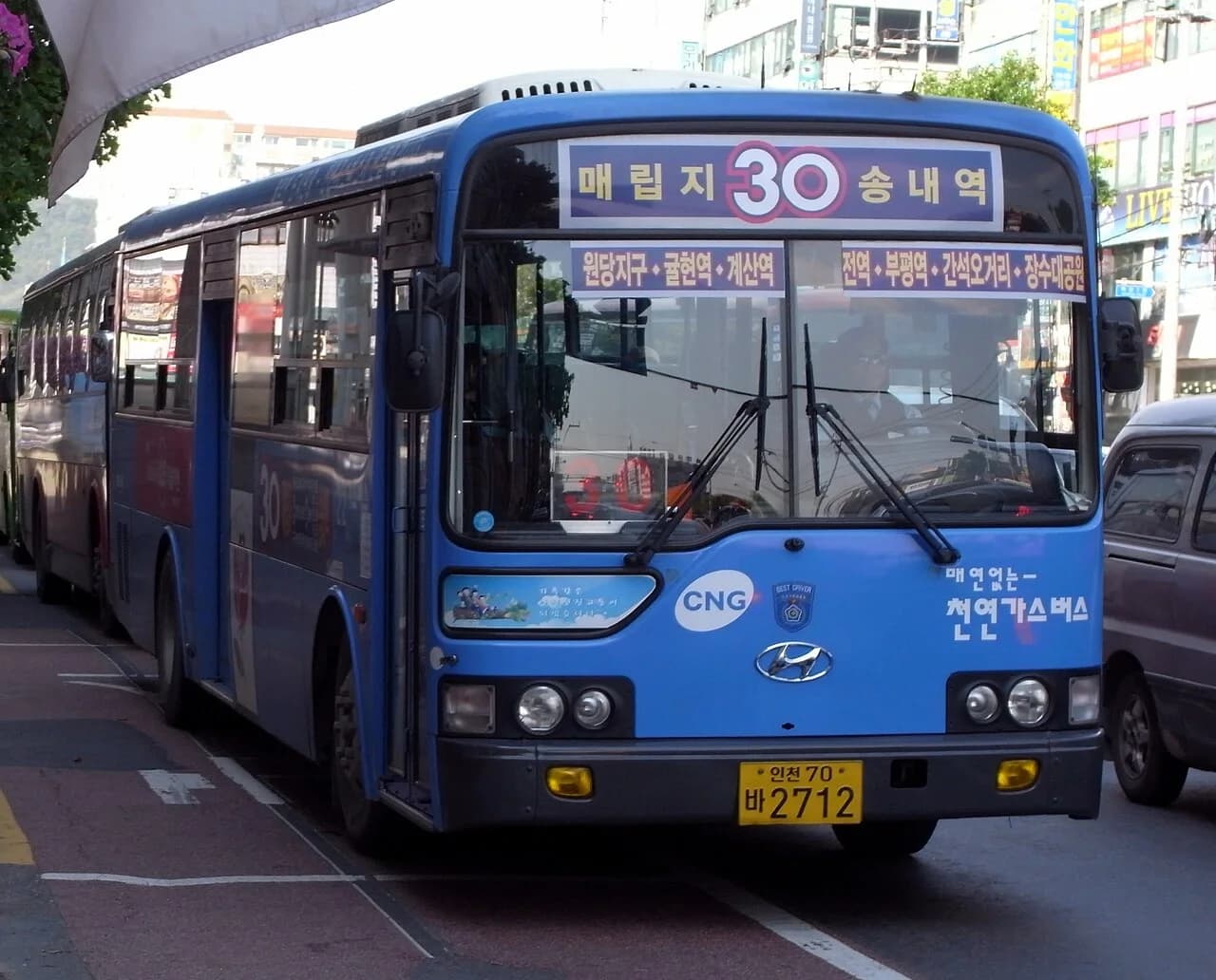
Photo: Dalgial, CC BY 3.0 · Incheon City Bus No 30.JPG

Summary
Board at the front door and tap your T-money or Climate Card on the reader. Tap again when you get off, because the transfer discount depends on that second tap. As of October 2026 a blue or green Seoul bus costs ₩1,500 by card or cash, but 183 routes no longer take cash, so carry a loaded card.
At a glance
- Fare
- ₩1,500 (blue or green)
- Pay with
- T-money or Climate Card
- Transfer
- Within 30 min (1 hour 9 p.m.–7 a.m.)
- Early fare
- 20% off before 6:30 a.m.
- Cash-free
- 183 routes
Step by step
How to ride a city bus in Seoul
Step 1 of 8 · Find the right bus
1Find your bus and stop
Find your bus number and stop name in a map app
곧 도착got dochakArriving soon
Read all steps as text
1. Find your bus and stop
Find your bus number and stop name in a map app
Korean you will see: 곧 도착 = Arriving soon
2. Read the bus color
Seoul colors its buses by route type
3. Check the front sign
Match the color, route number and end stop
Korean you will see: 중앙시장 방면 = Toward Central Market (the end stop)
4. Board at the front and tap
Board at the front door and tap your card
Korean you will see: 카드를 대 주세요 = Tap your card here
5. Know the cash rules
Blue or green bus: ₩1,500 for adults, card or cash
Korean you will see: 현금 없는 버스 = Cash-free bus (illustrative sticker)
6. Press the stop button
Press a stop button as your stop comes up
Korean you will see: 하차벨 = Stop button: tells the driver to stop (sign is an example)
7. Tap off when you leave
Tap your card on the reader by the door as you leave
Korean you will see: 하차 = Getting off: tap here
8. Transfer in time
Board within 30 minutes of getting off
Korean for this
이거 서울역 가요?
igeo seoullyeok gayo?
Does this go to Seoul Station?
버스 정류장이 어디예요?
beoseu jeongnyujangi eodiyeyo?
Where is the bus stop?
여기서 내려요
yeogiseo naeryeoyo
I'm getting off here
서울역에서 내려야 해요. 알려 주세요
seoullyeogeseo naeryeoya haeyo. allyeo juseyo
I need to get off at Seoul Station. Please tell me.
Details
Seoul's buses reach places the subway doesn't, and they use the same transit card. The rules are simple, but the order matters: tap on, tap off, and check which way the bus is going before you board.
Before you start
- A loaded transit card. T-money or the Climate Card both work. See the T-money guide and the transit card comparison for where to buy and top up.
- A map app with live arrivals. Naver Map and KakaoMap show which bus to take and when it arrives. See map apps for Korea.
- Your destination in Korean. Have the stop name or address in Korean script so you can match it on the app and the stop sign.
- Coins and small notes, but don't count on cash. As of the January 2026 route list, 183 Seoul routes run as 현금 없는 버스hyeongeum eomneun beoseuCash-free bus.
Read the bus color first
Seoul colors its buses by route type. The color tells you roughly how far the bus goes before you read the number.
| Color | Korean name | What it does |
|---|---|---|
| Blue | 간선ganseonTrunk | Long routes across districts, along main roads |
| Green | 지선jiseonBranch | Links subway stations and blue routes with neighborhoods |
| Yellow | 순환sunhwanCircular | Loops around the city center |
| Red | 광역gwangyeokWide-area | Connects Seoul with surrounding cities; higher fare |
| Small green | 마을버스maeul beoseuVillage bus | Short routes inside one neighborhood |
Late-night buses, called 심야simyaLate-night buses, have their own fare and route numbers that start with N.
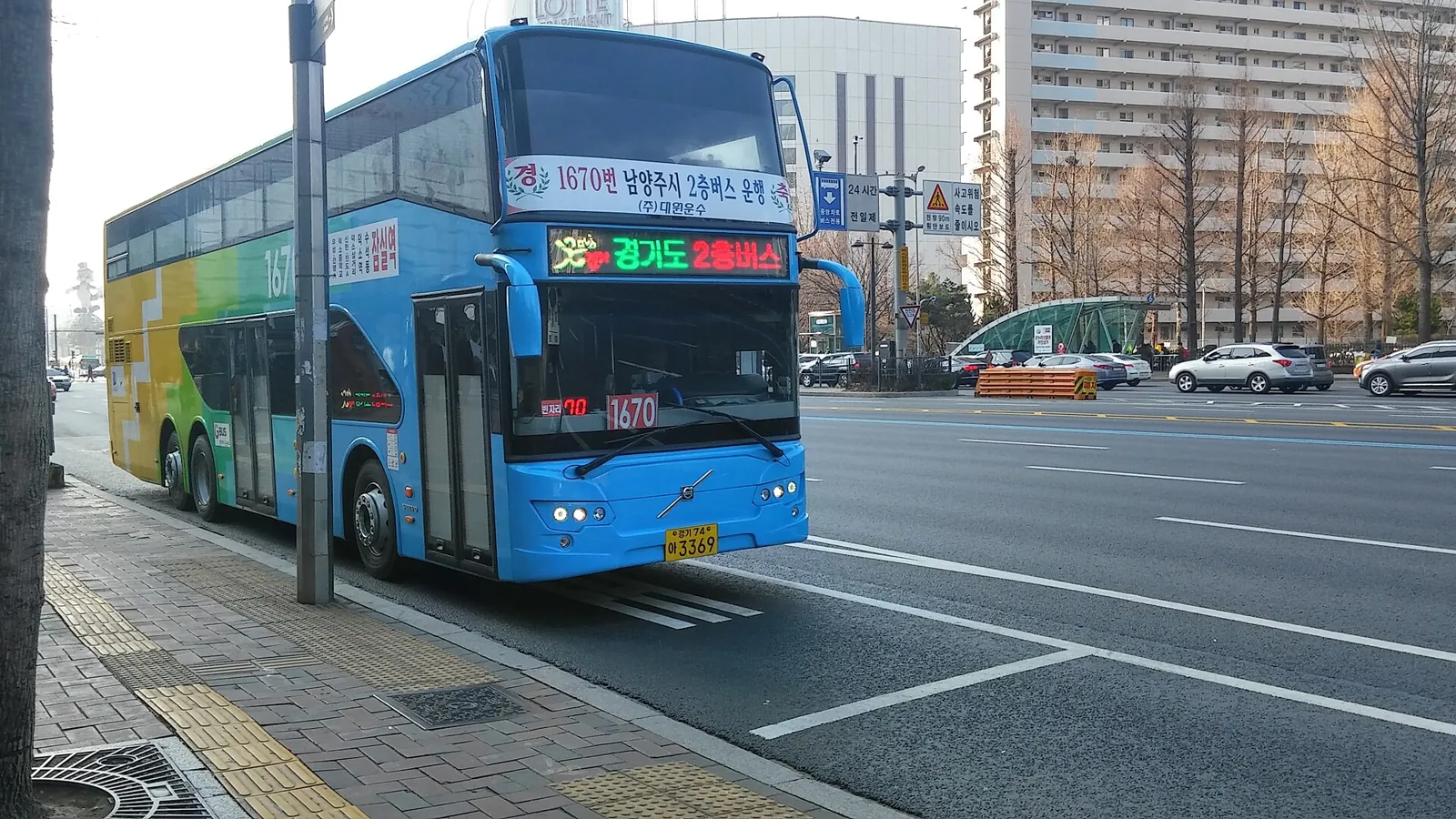
Step by step
Step 1 — Find the right stop and side of the road
Search your destination in a map app and note the bus number and the stop name. Stops with the same name often sit on both sides of a road, one for each direction, so check that the next stop in the app matches the direction you want.
At most stops a digital arrival board lists the buses due next. A bus marked 곧 도착got dochakArriving soon is about to pull in. Seoul's newer boards also show a bus icon next to that label and can mark low-floor buses with 저상jeosangLow-floor.
Step 2 — Check the front sign before you step on
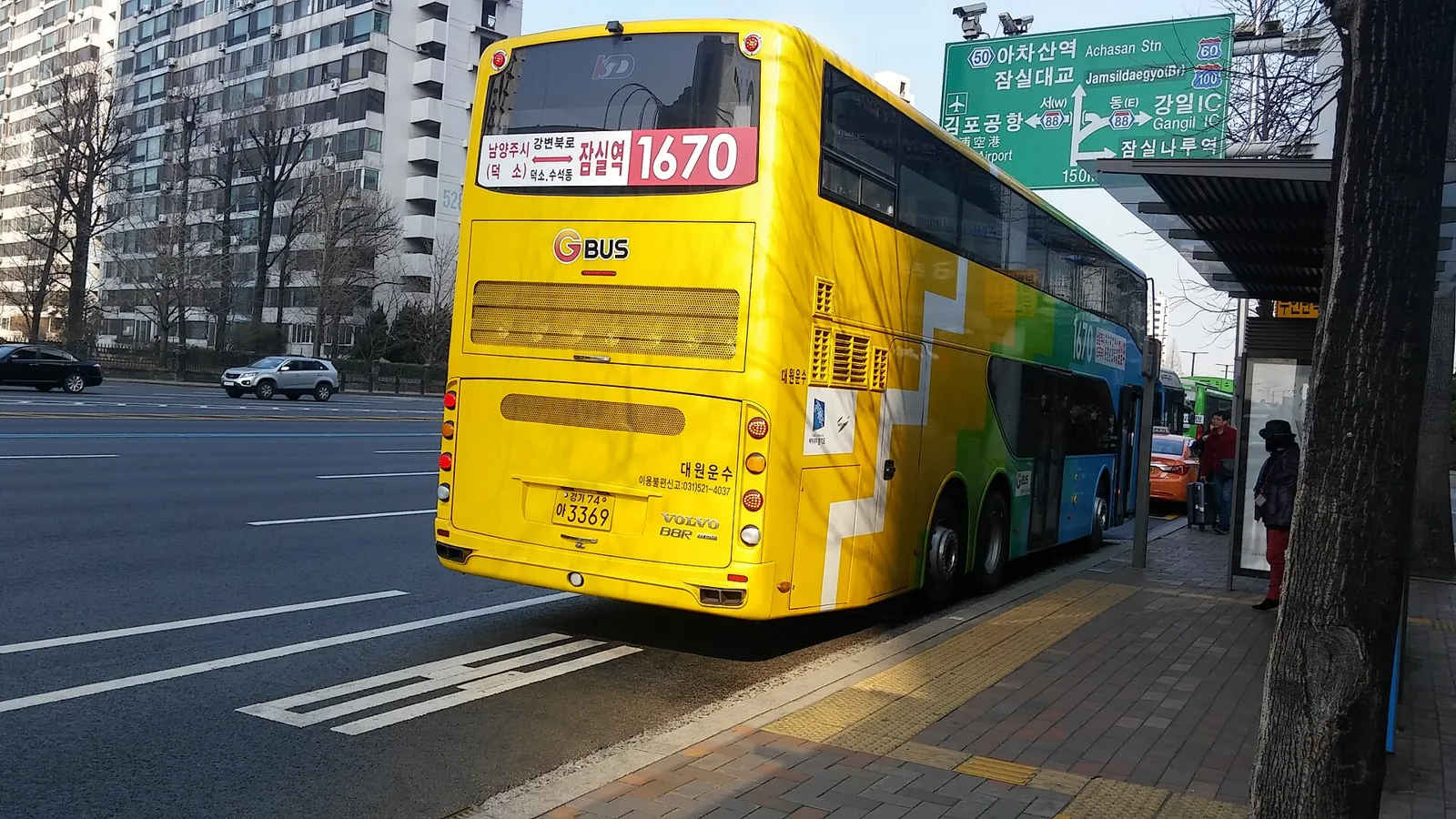
Match three things on the front of the bus: the color, the route number, and the end stop. The same number runs in both directions, and only the destination tells you which way this bus is going.
Step 3 — Board at the front and tap
Get on through the front door and hold your card flat on the reader next to the driver until it beeps. Hold a rail before you walk down the aisle, because buses often pull away right after the doors close.
Step 4 — Signal your stop
Follow your live position in the map app, since announcements are easy to miss. Press one of the stop buttons on the poles or walls as your stop comes up, so the driver knows to stop.
Step 5 — Tap off and get off
Tap your card on a reader by the door as you leave. Seoul's rules require this tap: without it, your next ride is charged as a new trip instead of a transfer. Most riders get off through the rear door.
Step 6 — Transfer within the time limit
If you tapped off, your next bus or subway ride counts as a 환승hwanseungTransfer:
- Board within 30 minutes of getting off, or within 1 hour between 9 p.m. and 7 a.m.
- Up to 4 transfers (5 rides) count as one trip.
- The trip is priced by distance: the base fare covers 10 km, then ₩100 is added for every 5 km.
- Getting back on the same route doesn't count as a transfer.
Fares as of October 2026
These fares have applied since 12 August 2023. Seoul's fare page was last updated in March 2026 and lists no newer change.
| Bus type | Adult (card or cash) | Teen (card) | Child (card) |
|---|---|---|---|
| Blue or green (간선·지선ganseon·jiseonTrunk and branch) | ₩1,500 | ₩900 | ₩550 |
| Yellow and some short branch routes | ₩1,400 | ₩800 | ₩500 |
| Red wide-area | ₩3,000 | ₩1,700 | ₩1,500 |
| Late-night N bus | ₩2,500 | ₩1,600 | ₩1,400 |
| Village bus | ₩1,200 | ₩600 | ₩400 |
- Card or cash costs the same for adults. Teens pay more in cash (₩1,000 on a blue bus), and the teen card fare only works with a registered youth card.
- Early-morning discount: card fares are 20% lower if you board before 6:30 a.m. This doesn't apply to late-night buses. For example, a blue bus costs ₩1,200.
- Climate Card short-term passes cost ₩5,000 for 1 day, ₩8,000 for 2 days, ₩10,000 for 3 days, ₩15,000 for 5 days and ₩20,000 for 7 days, plus ₩3,000 for a physical card. They cover Seoul-licensed city and village buses, including late-night and circular routes. They don't cover red wide-area buses, airport buses, or buses licensed by other cities.
Airport buses work differently
Airport limousine buses aren't city buses. They have their own fares, and the Climate Card doesn't cover them. For routes, prices and tickets from Incheon, see Incheon Airport to Seoul.
Common problems
The driver won't take your cash. You're probably on a cash-free route. Get off, buy or top up a T-money card at a convenience store, and catch the next bus.
The bus went the wrong way. Get off at the next stop, cross to the stop on the other side, and check the end stop on the front sign before boarding again.
You forgot to tap off. You'll pay a full new fare on your next ride instead of the transfer price. Tap off every time, even when the door would let you leave without it.
Your card beeps with an error. The balance may be too low for the fare. Top up at a convenience store or a subway station machine.
Your bus isn't on the arrival board. Arrival boards and apps refresh separately and can differ by a minute or two. Leave a small buffer, especially for the last bus of the night.
Questions and answers
Do I really have to tap when I get off?
Yes. Seoul's fare rules say you must tap the reader when you get off. That tap is what lets your next ride count as a transfer and lets the system work out the distance fare.
Can I tap my foreign credit card on the bus reader?
We couldn't confirm that on 20 October 2026. Seoul has announced plans to accept overseas cards directly on buses, but we found no notice that this has started. Use a T-money or Climate Card for now.
Does the Climate Card work on red buses?
No. Red wide-area buses, airport buses and buses licensed by other cities aren't covered. Seoul's city buses, village buses and late-night buses are.
Are bus and subway transfers free?
They're discounted, not free. When you tap off and transfer in time, you pay one fare for the whole trip by distance instead of a new base fare for each ride. Transfers between buses and the Seoul subway both count.
How do I know which bus goes where I'm going?
Use a map app. Search your destination and pick a public transit route. The app shows the bus number, the stop and how long until the next bus arrives.
Are there buses after midnight?
Yes, on selected routes. Late-night buses have numbers that start with N and cost ₩2,500 for adults. Check the map app for the routes and times that night.
Official sources (8)
Last checked October 20, 2026Next check due January 18, 2027
- Bus (fares, transfer rules, route colors) — Seoul Metropolitan Governmentaccessed October 20, 2026
- 서울 시내·마을버스 요금표 (2023.8.12. 적용, page updated 2026-03-09) — Seoul Metropolitan Government, Transportaccessed October 20, 2026
- 현금 없는 버스 운영 노선번호 안내 ('26.1월 기준) — Seoul Metropolitan Government, Transportaccessed October 20, 2026
- 기후동행카드 (coverage and short-term passes, page updated 2026-10-12) — Seoul Metropolitan Government, Transportaccessed October 20, 2026
- 버스정류소 버스정보안내단말기 신형 교체 ('곧 도착' display, low-floor marker) — Seoul Metropolitan Government, Transportaccessed October 20, 2026
- Transportation: buses and taxis — Seoul Tourism Organization (Visit Seoul)accessed October 20, 2026
- 서울버스 알림판 새단장…노인·외국인도 보기 쉽게 (bus icon on arrival boards) — Hankyung (news)accessed October 20, 2026
- 신용카드 하나로 서울여행 가능해진다 (plan for overseas cards on buses and subway) — Asia Economy (news)accessed October 20, 2026
Rules can change. Confirm on the official site before you travel.
Related guides
How to Buy, Top Up and Refund a T-money Card in Korea (2026)
Buy a T-money card at a convenience store, top it up with cash at a subway machine, check the balance and get your money back. Checked October 2026.

How to Ride the Seoul Subway: Tickets, Gates, Transfers (2026)
Read station numbers, buy a single-journey ticket, tap through the gates, follow transfer signs and get your ₩500 deposit back. Checked October 2026.
Naver Map vs KakaoMap: Finding Your Way in Korea (2026)
Why Google Maps falls short in Korea, how to search in Naver Map and KakaoMap, and how to read transit routes, exits and walking directions.

T-money vs Climate Card vs WOWPASS: Which Card for Korea? (2026)
Neutral comparison of T-money, Mobile T-money on iPhone, Seoul's Climate Card passes, WOWPASS and single tickets: cost, top-up, coverage, refunds.

Incheon Airport to Seoul: AREX, Airport Bus or Taxi? (2026)
Compare AREX trains, airport limousine buses, late-night buses and taxis from Incheon Airport to Seoul: fares, times, where to board. Checked October 2026.