

What You Need: Just One Card
A single T-money card covers subway, bus, and most convenience-store payments across the country, and it's the only piece of gear this guide requires. Buy one at any GS25, CU, 7-Eleven, or Emart24, or at a vending machine inside a subway station. As of July 2026, a single ride costs ₩1,550 with the card — covering the first 10 km, with roughly ₩100 added for every 5 km beyond that — a bit more if you pay cash instead.
Say the whole request out loud when you buy one: "a card, topped up," not just "a card." Asking for the card alone gets you a piece of plastic with no money loaded on it — a mistake that only becomes obvious once you're standing at the turnstile with a card that won't open the gate. The card itself runs roughly ₩3,000–5,000 depending on the design, billed separately from whatever balance you load, and both amounts have shifted over time, so confirm the current price at purchase rather than from an old travel post.
If you'd rather skip a physical card, some smartphones support a mobile T-money option registered through NFC — useful if you're already juggling a passport, phone, and boarding pass and would rather not add plastic to the pile.
Tapping In and Out, Step by Step
The turnstile's card reader is the flat panel on top of the gate, not the screen and not the side rail. Hold the card against it — inside a phone case is fine — until the panel flashes and the gate opens.
The part visitors from tap-in-only systems consistently miss: the Seoul subway requires a tap on the way out too. Buses have always worked that way, but a subway platform gate that lets you walk straight through when leaving trains people into skipping the exit tap out of habit. Do it anyway. Every station exit has the same reader mounted on its gate.
Miss the exit tap and nothing stops you from leaving the station, but the system has no record of where your trip ended. Your next tap-in gets charged as if you traveled the maximum possible distance, and the only fix is a station staff window, not a self-service kiosk.
Transfer Rules: How Many, and How Fast
Transfers between subway and bus, or bus and bus, are free — up to five on a single fare chain, as of July 2026 — within a set window that starts counting from the moment you tag out of the first leg, not from when you boarded it: 30 minutes during the day, stretched to 60 minutes between 9 p.m. and 7 a.m. Miss that window and the next tap-in is billed as an entirely new ride from zero, not a transfer.
The part that catches people out: the clock starts at your exit tag, not at some fixed number of minutes after you got off the train. Walk slowly through a large interchange station, stop for photos, or grab a coffee before continuing, and you can burn through the transfer window without realizing it. If your route includes a transfer, treat the walk between platforms as timed, not leisurely.
Riding a Lot in One Day? When the Climate Card Wins
Seoul's Climate Card is an unlimited-ride pass covering subway and bus within a defined zone. As of July 2026, a one-day pass costs ₩5,000 against a ₩1,550 T-money base fare, so the math tips toward the pass once you're taking roughly four or more rides in a day — worth a quick calculation against your actual plan rather than assuming either option by default. One change worth knowing before you buy: the 30-day version of the pass is being phased out and can only be recharged through 31 July 2026. What's left for longer stays is the short-term lineup — ₩5,000 for one day up to ₩20,000 for seven — so confirm current pricing and coverage at Seoul's official Climate Card page.
The exclusion that surprises people: the Climate Card doesn't cover every line in the metro area, and the airport railway (AREX) is a common gap. Travelers who assume "unlimited" means every train in the system sometimes find that out at an AREX gate that simply won't open for their pass. If your day includes an airport trip, check the current coverage map before counting on the pass for that leg.
Not Getting Lost: Line Colors and Exit Numbers
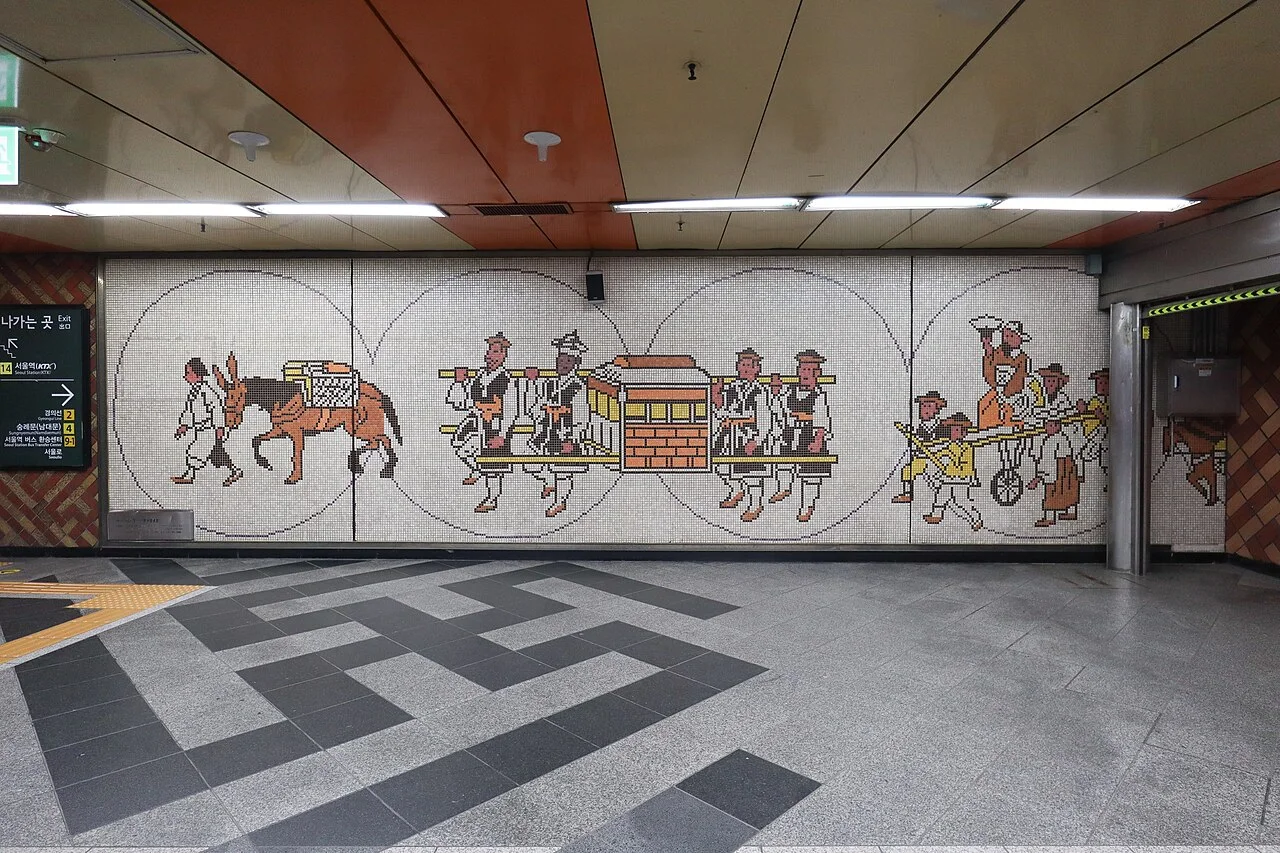
Seoul's subway lines are numbered and color-coded, and both the number and color appear together on maps, signage, and train cars — useful because remembering "the orange line" is often faster under time pressure than remembering "Line 3."
Interchange stations are where the color system earns its keep, but they're also where people get turned around. It's common for a major transfer station to have ten or more numbered exits fanning out in different directions, and picking the wrong one means walking back down, crossing underground, and coming back up on the far side of an intersection — a detour that can cost more time than the entire train ride. Look up your destination's specific exit number before you arrive at the station, not after you're standing at the top of the stairs.
Last trains run at different times depending on the line and direction, generally clustering around midnight, but not on a single citywide clock. Check the current schedule for your specific line through a transit app or the posted timetable at the station rather than assuming every line runs until the same hour.
Heavy Luggage or Limited Mobility: Use the Wide Gate
Standard turnstiles are built for a person, not a person plus a 28-inch suitcase. Every station has at least one wide gate, usually positioned next to the staff booth, designed for wheelchairs, strollers, and larger luggage.
Forcing a large bag through a regular turnstile risks getting it wedged in the closing gate — an outcome that's more common than it should be. If the wide gate looks closed or unclear, station staff will open it on request. It's a small ask that saves both time and a potential jam at the gate behind you.
Getting a Refund on Your Leftover Balance
T-money balances don't expire, but if you're not planning a return trip soon, a station ticket office or a participating convenience store will refund the remaining amount minus a small handling fee. The card purchase price itself is generally not refunded — only the unused top-up balance.
The practical move is loading roughly what you expect to spend rather than a large round number "just in case." A big balance left over at the end of the trip means a larger chunk lost to the refund fee than if you'd topped up in smaller amounts along the way.