

What Made This List: Standing, Simple to Order, Not Locked to One Season
This list sticks to food you can order standing up, with a simple point-and-pay exchange, no reservation and no seat required — it leaves out the sit-down stall restaurants that share the same market alleys but run more like a regular restaurant. A couple of seasonal items are included anyway, since they're common enough to expect, with a clear note on when you'll actually find them.
Tteokbokki and Twigim: The Everywhere Combo, and What It Costs
Tteokbokki (spicy rice cakes in a red sauce) and twigim (an assortment of deep-fried items — vegetables, mandu dumplings, sometimes a whole fried squid leg) are sold together often enough that ordering one without being offered the other would be the unusual outcome. As of July 2026, a serving of tteokbokki at a standing stall commonly runs somewhere around ₩3,000–5,000, with twigim priced by the piece; prices vary by vendor and market, so check the posted price rather than assuming a fixed number.
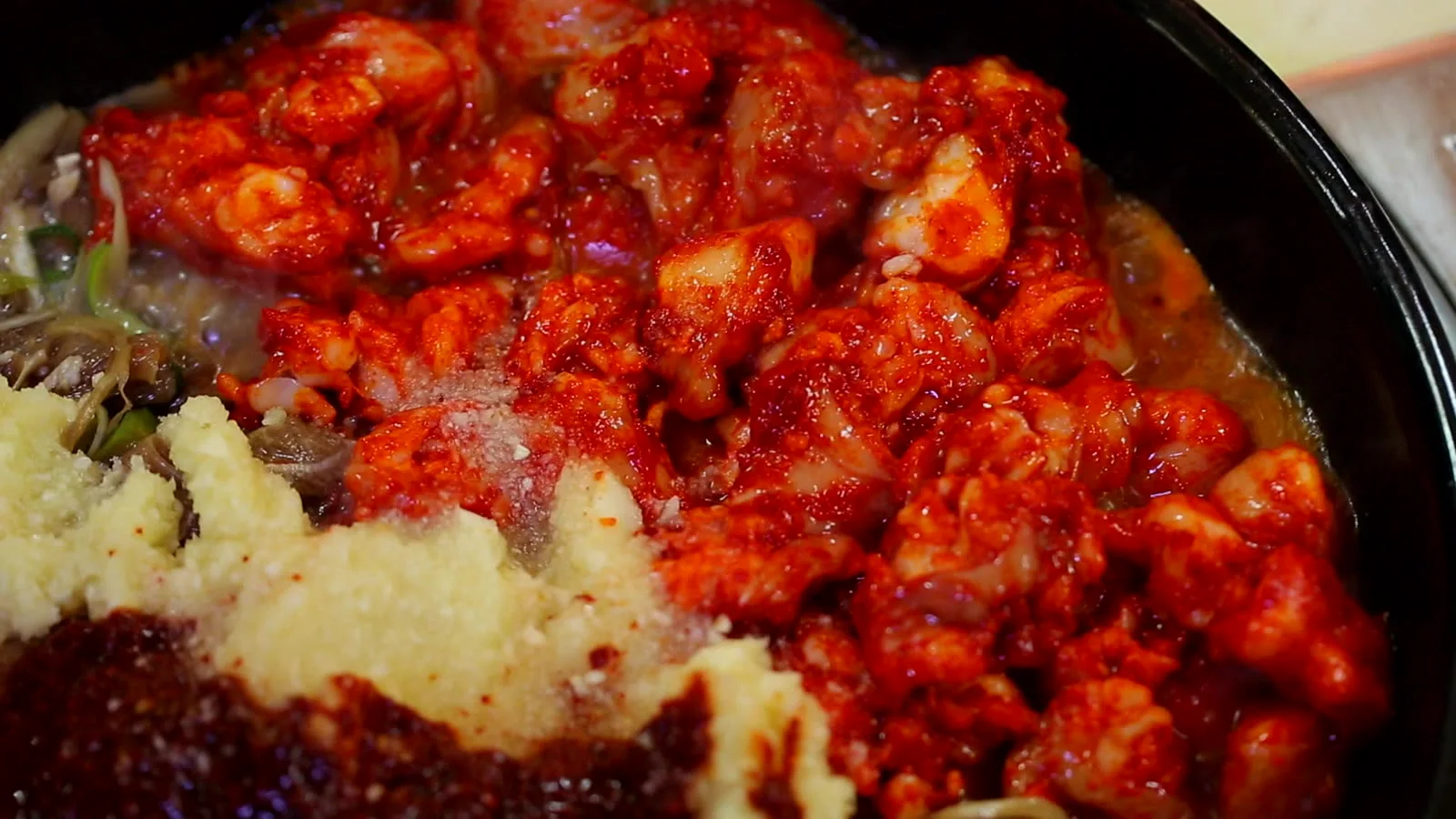
Dipping a piece of twigim into the tteokbokki sauce has become close to the default way to eat the combo, and plenty of stalls hand over a spoonful of sauce with your fried order even if you didn't ask for it specifically. Whether the fried items are billed separately from the rice cakes or bundled into one price differs by stall — worth a quick ask before you start eating if the total matters to you.
Hotteok and Bungeoppang: Cold-Weather Items, Not Year-Round
Hotteok (a fried, filled pancake, usually stuffed with a brown-sugar-and-nut mix) and bungeoppang (a fish-shaped pastry filled with sweet red bean) are both seasonal street snacks tied to cold weather, generally appearing from late autumn through winter and disappearing once temperatures climb.
Searching for either one in the middle of summer usually turns up closed carts or no vendors at all in a spot that was busy with them a few months earlier. If you're visiting outside the cold months, treat these two as items to plan around on a return trip rather than something to chase down in July.
Eomuk Skewers and Broth: Serve Yourself, Pay by the Count
Eomuk (fish cake) skewers are commonly set up as a self-serve arrangement: a shared pot of hot broth sits at the stall, with skewers standing upright in it, and you pull one out yourself rather than ordering it made to order. Eating standing at the stall while sipping the broth from a small paper cup is part of the normal routine, not an extra request.
Payment is typically counted after the fact, based on however many skewers you ate — some stalls ask you to keep the empty skewer sticks rather than tossing them, so the vendor can count what you had. Throwing your skewer away out of habit can leave you fumbling to explain how many you actually ate.
Payment: Why Cash Still Matters at a Standing Stall
Card readers have spread to plenty of market stalls, particularly the larger and more visible ones, but a real portion of standing food carts and small vendors remain cash-preferred or cash-only. Carrying a mix of ₩1,000 and ₩5,000 notes covers most street food purchases without forcing a vendor to break a larger bill mid-rush.
If you run out of cash mid-visit, convenience stores at or near most major markets typically have an ATM, and many display a "Global" or international logo indicating it accepts foreign-issued cards — worth checking the sticker on the machine itself rather than assuming any ATM will work with your card.
Exact or close-to-exact change also speeds things along at a busy cart — small vendors don't always keep a large float of change on hand, and breaking a big note during a lunchtime rush can hold up the line behind you longer than you'd expect for a ₩3,000 order.
Market Personalities: Gwangjang's Speed, Tongin's Coin Lunchbox, Mangwon's Everyday Shopping
Not every traditional market serves the same purpose, and picking the wrong one for what you actually want to do costs you time. Gwangjang Market is built around eating: a dense concentration of stalls cooking to order, with fast turnover and a layout clearly oriented toward visitors grabbing food rather than groceries.
Tongin Market runs a distinct experience: buy a set of old-style brass coins (yeopjeon) at the entrance booth, then use them to fill a tray at whichever stalls catch your eye around the market — a self-directed lunchbox rather than a single stall's fixed menu. Mangwon Market, by contrast, leans toward everyday neighborhood shopping — produce, side dishes, household goods — with a food-stall section that's noticeably smaller than at either of the other two, since it caters more to residents doing their weekly shopping than to visitors looking for a meal.
If eating is the actual goal for your visit, Gwangjang is the more efficient choice of the three; Tongin suits visitors who want the coin-lunchbox novelty specifically, and Mangwon suits a slower, more local-feeling wander with food as a secondary stop.
Gwangjang is also commonly cited as one of Korea's oldest surviving traditional markets, tracing back to the early 1900s — a detail that doesn't change how you order, but explains why its layout feels denser and more established than a newer market redevelopment. Stall hours run later into the evening than a typical retail shop, though individual vendors set their own schedule, so confirm on the official pages linked below if you're timing a visit around a specific stall.
Judging What Looks Safe to Eat
A reasonably reliable read on a stall, without needing any Korean at all: watch whether food is cooked or reheated right in front of you, and whether the line is actually moving. A stall frying twigim to order as customers wait, or ladling tteokbokki from a pot that's visibly being replenished, is generally a safer bet than a tray of pre-made food that's been sitting under a heat lamp for an unknown stretch of time.
Busy stalls end up safer almost by accident — high turnover means less time for anything to sit around, which is as good a rule of thumb as any specific inspection you could try to do yourself as a visitor.
Spice Levels, Allergies, and Limited Vegetarian Options
Asking for something "less spicy" tends to land differently at a street stall than at a sit-down restaurant. Most tteokbokki sauces and eomuk broths are prepared in a single batch ahead of time, cooked in bulk and kept going throughout the day, which means there's often no per-order way to dial back the heat even if a vendor is happy to try.
The same batch-cooking setup limits how well allergy information travels — pointing at an ingredient and asking directly gets a clearer answer than a general statement like "allergic." Vegetarian options are genuinely thin on the ground at most standing stalls, since fish-based broths and sauces show up in items that don't look obviously seafood-based, including some tteokbokki sauce bases; if avoiding fish or meat matters, asking before ordering is worth the extra minute it takes.