
Korea Autumn Foliage 2026: When and Where to See the Leaves
Photo: Joycekim77, CC BY-SA 3.0 · Seoraksan in the Fall 3- 설악산 단풍.jpg

Summary
In 2026 the Korea Forest Service forecasts peak foliage on Seoraksan on 20 October, Songnisan on 28 October, Naejangsan on 4 November and Hallasan on 6 November. Its peak means at least half the leaves have changed. The Korea Tourism Organization's forecast is later (Seoraksan 25 October), so treat dates as a range. Forecasts are issued each September for that year.
At a glance
- Seoraksan peak (KFS)
- 20 October 2026
- Songnisan peak (KFS)
- 28 October 2026
- Naejangsan peak (KFS)
- 4 November 2026
- Hallasan peak (KFS)
- 6 November 2026
- KFS definition of peak
- at least half the leaves
- Forecast year
- 2026 only
Details
Korean maples and ginkgoes turn from north to south and from the high mountains down to the cities, over about six weeks. In Korean the leaves are 단풍danpungAutumn foliage, and a trip to see them is 단풍놀이danpungnoriFoliage outing. This guide explains how to read the official forecasts, where to go and how to get there. It is written on 20 October 2026 and the dates apply to 2026 only.
When the leaves turn
Foliage does not peak on a fixed date. It moves with temperature, and each agency defines "peak" differently:
- Korea Forest Service (KFS): the peak is the day at least half the leaves on a mountain have changed color.
- KMA: the peak is when 80% of the mountain, counted from the summit down, has changed (Maeil Shinmun).
- The same mountain can show peak dates 3 to 10 days apart depending on which definition is used (Maeil Shinmun).
- The KTO page does not define "first foliage" or "peak foliage."
The 2026 forecasts
The KFS published its "2026 Fall Foliage Peak Prediction Map" on 22 September 2026. The first foliage of the year was observed on the 14th at Jeombongsan in Inje, Gangwon (Kyunghyang Shinmun English).
| Place | KFS predicted peak (2026) | KTO forecast peak (2026) |
|---|---|---|
| Seoraksan | 20 October | 25 October |
| Bukhansan | not listed | 4 November |
| Songnisan | 28 October | not listed |
| Jirisan | 27 October | 5 November |
| Naejangsan | 4 November (maple), 26 October (oak) | 11 November |
| Hallasan | 6 November | 13 November |
KFS predicts peaks of 20 October 2026 on Seoraksan, 28 October 2026 on Songnisan, 4 November 2026 on Naejangsan and 6 November 2026 on Hallasan.
Sources: KFS dates from Kyunghyang Shinmun English and Maeil Shinmun; KTO dates from VisitKorea 2026 Fall Foliage Forecast, which credits the private forecaster Weatheri and was published on 8 September 2026.
The two forecasts conflict, with the KTO dates about 5 to 8 days later. KFS also expects the nationwide peak for maple and oak trees on 31 October and for ginkgo on 30 October. KFS says this year's peak is about 0.8 days later than the five-year average (Kyunghyang Shinmun English). On 15 October the National Recreation Forest Management Office added a map for recreation forests: Sambong 21 October, Yumyeongsan 31 October, Jirisan 2 November and Jindo around 17 November (Herald Business).
KTO and the Korea National Arboretum also released a 2026 Autumn Leaves Map with 36 destinations, based on reports from 829 citizen observers. It puts the Seoul area and Gangwon at a late-October peak and Gyeongsang and Jeolla in early to mid-November (The Korea Times).
Rain, strong wind or a long warm spell can shift the peak or shorten it (Maeil Shinmun). Forecasts appear each September for that year, so there is no official 2027 forecast yet. For current dates, check the Korea Forest Service and the VisitKorea forecast.
Where to go
National parks and mountains
- Seoraksan, Sokcho (Gangwon). Usually the first to peak. The Ulsanbawi trail is 7.6 km and about 4 hours. The Daecheongbong trail is 16 km and about 10 hours. A cable car runs to Gwongeumseong Fortress (VisitKorea). Upper trails from Biseondae Canyon to Daecheongbong are closed from 15 November to 15 December (VisitKorea).
- Naejangsan (Jeollabuk-do). Known for the maple tunnel between the Iljumun Gate and Naejangsa Temple, and one of the last big sites to peak.
- Bukhansan, Seoul. On the city edge; the Baegundae trail is 9 km and about 5 hours, and some sections are closed because of rockfall risk, so check status first (VisitKorea).
- Hallasan, Jeju. The summit trails need a reservation and have limited daily capacity (VisitKorea).
Seoul and the capital area
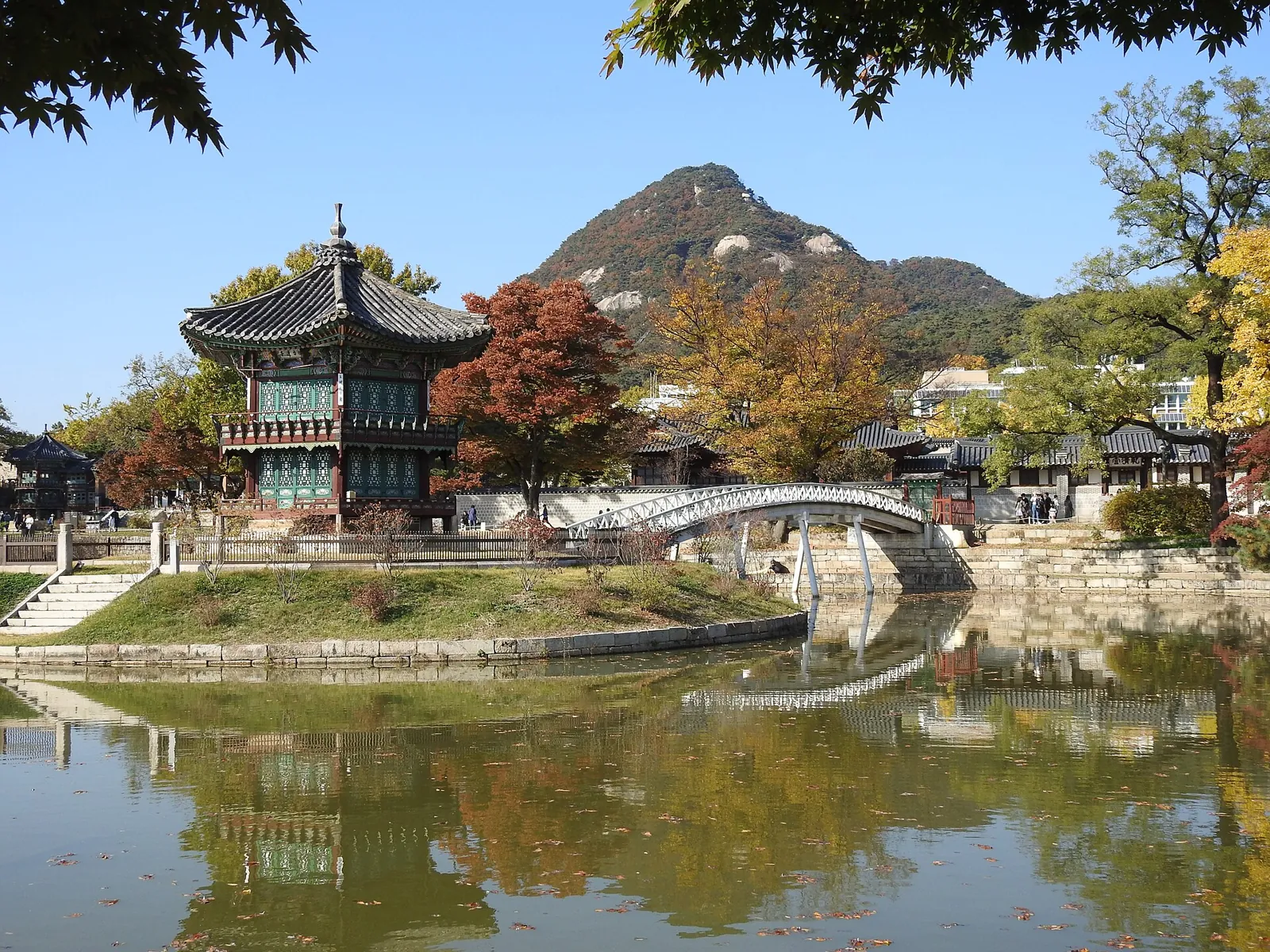
KTO's 2026 forecast names Gyeongbokgung Palace, Seoul Forest, Olympic Park and N Seoul Tower in Seoul, and Hwadam Botanic Garden, Nami Island and The Garden of Morning Calm on the outskirts (VisitKorea). The Korea Times list for the 2026 Autumn Leaves Map also names Incheon Grand Park (maple tunnels) and the Hantan River Canyon at Goseokjeong, Cheorwon.
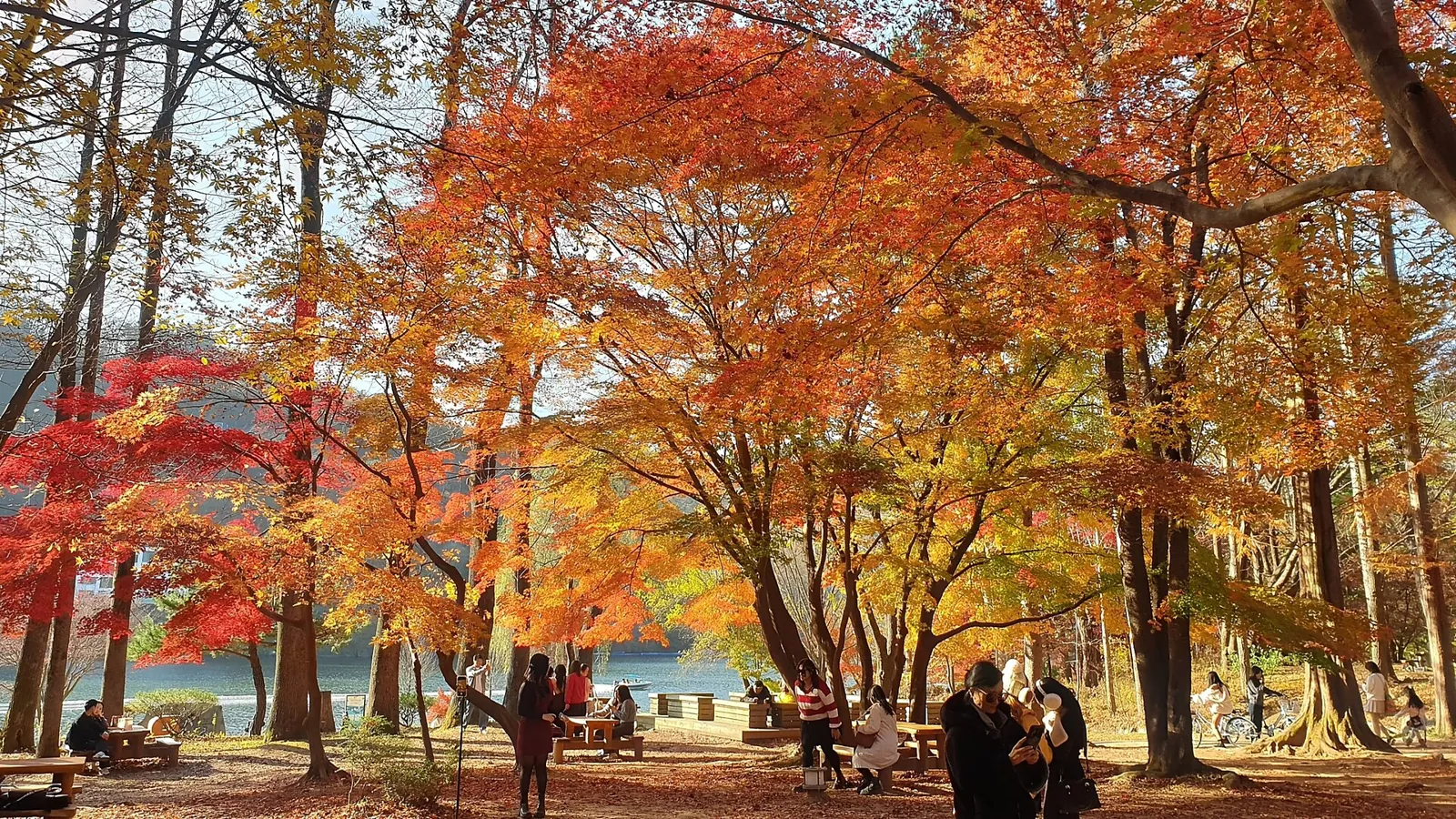
Nami Island opens daily from 08:00 to 21:00 year-round. Ferries run from Gapyeongnaru Pier, every 30 minutes from 08:00 to 09:00 and every 10 to 20 minutes from 09:00 to 18:00. Regular admission is ₩19,000 and includes the ferry (VisitKorea). Check the island's official site before you go, because schedules can change.
Farther away
The Korea Times list also names the ginkgo reflections at Mungwang Reservoir in Goesan, Metasequoia Road in Damyang and the pampas grass at Ttarabi Oreum on Jeju. The Seoul Silver Grass Festival at Haneul Park runs until 23 October 2026.
Getting there by public transport
- Seoul to Sokcho (for Seoraksan). Express buses leave from Seoul Express Bus Terminal and Dong Seoul Terminal. Then take Bus 7 or 7-1 from Sokcho Intercity Bus Terminal to Seoraksan Sogongwon Park (VisitKorea).
- Bukhansan. Take Bus 704 from the Seoul Station Bus Transfer Center to the Bukhansanseong stop, or Subway Line 1 to Dobongsan Station (VisitKorea).
- Hallasan. Bus 181 or 281 to Seongpanak, or Bus 240 to Yeongsil (VisitKorea).
- Buying bus tickets. Use the English-language Kobus site, or buy at the terminal. Boarding usually opens 5 to 10 minutes before departure (VisitKorea). For trains, see KTX and trains.
Crowd tips
- Go on a weekday if you can. Seoul's city government asks visitors to use public transport at peak events because roads are very congested (Seoul Metropolitan Government).
- Book bus seats early for weekends, and start hikes in the morning.
- Pick a second site as a backup. Peak dates move, and a single mountain can be a week early or late.
- Check which trail sections are closed before you leave.
What to wear
KTO warns that autumn temperatures can fluctuate greatly (VisitKorea). Seoul's averages are 20.2°C high and 10.6°C low in October, and 11.9°C and 3.5°C in November (KMA). It is colder on a summit than in town.
- Wear layers and a windproof jacket.
- Wear shoes with grip, since wet leaves are slippery.
- Bring a hat and gloves for November.
- Carry water and a light snack on trails.
See Korea in October and Korea in November for monthly details.
Questions and answers
When is the best time to see autumn leaves in Korea?
In 2026, the forecast for the mountains in the north is mid to late October, the Seoul area is late October, and the south and Jeju are in early to mid-November.
Which forecast should I trust?
Use both. KFS and KTO differ by up to about a week. Check the official pages again the week you travel.
Will the same dates apply in 2027?
No. These are 2026 forecasts. Forecasts for 2027 had not been published as of 20 October 2026.
Next: Korea in November.
Official sources (15)
Last checked October 20, 2026Next check due November 19, 2026
- Korea Forest Service 2026 Fall Foliage Peak Prediction Map (released 2026-09-22) — Kyunghyang Shinmun (English), reporting the Korea Forest Serviceaccessed October 20, 2026
- 2026 foliage peak dates, KFS and KMA peak definitions (2026-10-16) — Maeil Shinmun, reporting the Korea Forest Service and KMAaccessed October 20, 2026
- 2026 National Recreation Forest Fall Foliage Peak Forecast Map (released 2026-10-15) — Herald Business, reporting the Korea Forest Serviceaccessed October 20, 2026
- Korea Forest Service (foliage forecasts) — Korea Forest Serviceaccessed October 20, 2026
- 2026 Fall Foliage Forecast (published 2026-09-08; forecast credited to Weatheri) — Korea Tourism Organization (VisitKorea)accessed October 20, 2026
- Crowdsourced data powers Korea's official autumn foliage road map (2026-10-08) — The Korea Times, reporting KTO and the Korea National Arboretumaccessed October 20, 2026
- Best hiking trails in Korea (Seoraksan, Bukhansan, Hallasan) — Korea Tourism Organization (VisitKorea)accessed October 20, 2026
- Nami Island — Korea Tourism Organization (VisitKorea)accessed October 20, 2026
- Nami Island official site — Namiseom Inc.accessed October 20, 2026
- Naejangsan National Park — Korea Tourism Organization (VisitKorea)accessed October 20, 2026
- Express Bus & Intercity Bus — Korea Tourism Organization (VisitKorea)accessed October 20, 2026
- Kobus express bus booking (English) — Korea Express Bus Terminal Association (Kobus)accessed October 20, 2026
- 25th Seoul Silver Grass Festival (제25회 서울억새축제) — Seoul Metropolitan Governmentaccessed October 20, 2026
- Best time to visit / seasons and what to wear — Korea Tourism Organization (VisitKorea)accessed October 20, 2026
- Climatological Normals of Korea 1991–2020 (한국기후표), station pages 108 Seoul, 159 Busan, 184 Jeju — Korea Meteorological Administrationaccessed October 20, 2026
Rules can change. Confirm on the official site before you travel.
Related guides

Korea in October 2026: Autumn Foliage, Holidays and Weather
October in Korea: official Seoul, Busan and Jeju averages, the 2026 foliage forecast, Hangul Day and what is left of the autumn festival season.

Korea in November 2026: Weather, Late Foliage and What to Wear
November in Korea: official Seoul, Busan and Jeju averages, southern foliage peaks, first frost and snow dates, and what to pack for the first cold weeks.

Korea Weather by Month: Seoul, Busan and Jeju Averages (2026)
Official monthly averages for Seoul, Busan and Jeju from the Korea Meteorological Administration, with what to wear each season and public holidays.

Seoul Travel Guide for First-Time Visitors (2026)
Seoul for first-timers: which area to stay in, how to get in and around, and the main sights with nearest station, exit number, hours and closing days.

KTX and Trains in Korea: Booking, Stations and Fares (2026)
Book KTX trains in English, pick the right Seoul station, and check Seoul–Busan fares and times. Includes the September 2026 SRT merger and the Korail Pass.