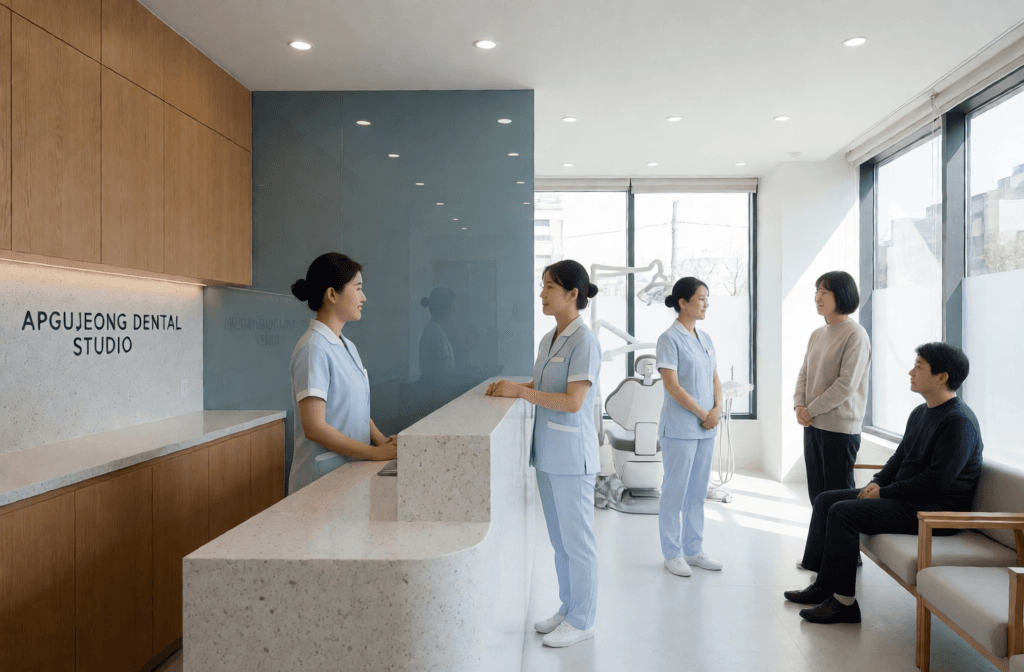
A common request at Korean dental clinics is some version of "I'm here for two weeks — can we finish this before I fly home?" The honest answer, for both clear aligners and braces, is no. What follows is what a short trip, or a longer one, can actually accomplish instead.
The conclusion first: orthodontics doesn't fit inside a trip
Both clear aligners and fixed braces require months of ongoing management — adjustment visits for braces, a new tray on a set schedule for aligners — regardless of where treatment starts. A short visit to Korea can begin that process. It can't complete it, no matter how efficient the clinic or how motivated the patient.
Everything below follows from that fact. Instead of asking which method finishes faster, the more useful question is what a short trip can realistically accomplish — diagnosis, records, a treatment plan, an initial device — and what has to happen afterward, wherever "afterward" turns out to be.
Clear aligners vs. fixed braces: what actually differs
| Criterion | Clear aligners | Fixed braces |
|---|---|---|
| Total treatment duration | Commonly discussed in months; the actual figure is set at diagnosis | Commonly discussed in months; the actual figure is set at diagnosis |
| Visit or check-in pattern | Trays typically changed on a set schedule; in-person check-ins spaced further apart | Adjustment visits typically needed every few weeks throughout treatment |
| Removability | Removable for eating and brushing | Fixed in place for the full duration |
| Remote monitoring | Some systems support app-based progress checks — confirm which system the clinic uses | Not typically monitored remotely; adjustments need an in-person visit |
| Suited to | Simpler alignment corrections, confirmed at assessment | Can also address more complex bite corrections aligners may not fully handle |
None of this ranks one method above the other. Aligners suit people who want to eat and brush without a fixed appliance in the way; braces stay on continuously and don't depend on wearing something a set number of hours a day. That's a lifestyle difference, not an effectiveness ranking.
Not every case is suited to aligners, regardless of preference. More complex bite corrections may specifically require fixed appliances — a call the orthodontic assessment makes after examining your bite and imaging, not something to negotiate from a photo of your teeth.
What a short trip to Korea can actually cover
Realistically, a Korea-based visit can cover diagnostic records — digital scans or physical models, photos, X-rays — the treatment plan itself, and an initial device: either your first set of aligner trays or the placement of braces. What it can't cover is completion.
That means at least one more visit is built into any Korea-based plan from the outset, whether that's a return trip to Korea, a handoff to a clinic back home, or some mix of both. This isn't "diagnosis now, device later" — the initial device is usually part of the same trip. It's what comes after that trip that needs its own plan.
Starting in Korea, continuing at home: what you need
Before leaving, arrange two things: diagnostic records and the treatment plan in a digital format — scan files, X-ray images, and a written plan — that your home orthodontist can actually use, and a clear point in that plan where responsibility hands off from one clinic to the other.
Confirm a receiving orthodontist back home before starting treatment in Korea, not after. A plan that begins with no confirmed home provider risks a gap in care — aligner trays that need changing on schedule, or braces that need adjusting, don't pause politely while you search for a new dentist after the fact.
Remote monitoring apps exist for some clear aligner systems and can partially bridge the gap between in-person visits. Confirm with the clinic which system they use and whether remote check-ins are actually supported for your treatment, rather than assuming every aligner brand offers the same feature.
When Korea isn't the right place to start
Some situations specifically complicate a Korea-start plan: needing extraction or jaw surgery alongside orthodontic treatment, or active gum disease that needs treating first. Both require close, in-person coordination that a single visit, or even a short series of visits, can't realistically provide.
That's not a reason to rule out Korea broadly — it's a reason to raise this directly with the orthodontist before committing to a plan built around a fixed trip length. A straightforward alignment case and a case needing extraction or jaw work are different undertakings, even when both start with the same first consultation.
What clear aligners or braces cost in Korea, billed in stages
Because treatment runs months past a single visit, Korean clinics typically bill it in stages rather than one lump sum at the start — the number worth knowing before you commit is the full-course total those stages add up to, not what the first visit alone costs. As of July 2026, full-course clear aligner treatment is commonly quoted in Korea at roughly ₩3,500,000–₩8,000,000, and full-course fixed braces usually land lower, roughly ₩2,000,000–₩5,000,000. Case complexity — how many stages or aligner sets a straightforward correction needs versus one requiring extraction or more extensive bite work — drives the spread inside each range more than the aligner brand does.
A Korea-based visit typically bills only its own stage of that total: diagnostic records, the treatment plan, and the initial device. Ask the clinic directly what portion of the full-course figure that first stage represents, and how remaining stages are priced if you continue with a different provider once you're home.
Both ranges above are planning figures only, tied to that date — not a quote, and not what any clinic has committed to charging your case specifically. Request a written, itemized quote broken out stage by stage, with a stated validity period attached. HIRA's non-covered (비급여) treatment cost information portal, in the sources below, is a lookup tool for what a specific clinic has itself declared — not a page this article can summarize a number from.
Questions to ask before starting treatment
Ask for the total number of stages or aligner sets, or an estimated treatment duration, and how that number could shift once treatment is underway — orthodontic estimates commonly move as teeth respond. Ask what happens if treatment is discontinued partway through, and specifically which unused stages, if any, are refundable.
Ask whether a retainer is included at the end of treatment or billed separately — retainers are easy to assume are included and just as easy to find aren't. Treat any cost figure as a range only, tied to an explicit as-of date, and confirm the actual number through the clinic's own itemized quote rather than a figure remembered from a forum post.
Warning signs in how orthodontic treatment is sold
A confirmed treatment duration stated before any diagnostic imaging has been done is a reason to slow down — that number genuinely can't be known with confidence until scans and photos exist. No mention at all of who manages the remaining months of treatment once you leave Korea is a gap worth raising directly rather than assuming it sorts itself out.
A single lump price with no breakdown of what's included per stage or per visit makes it hard to know what you're actually agreeing to, and harder still to compare against a second clinic's quote.
This article covers alignment correction only. Two other common dental procedures — dental implants and veneers and crowns — follow a different visit structure and have their own guides, as does dental implant cost in Korea, and why it's two trips for cost specifics. For how many days a dental-related visit typically needs before flying home, see how many days to stay in Korea.
Sources
- Korean Dental Association (KDA, English)
- Ministry of Food and Drug Safety (MFDS, English)
- Medical Korea (KHIDI) — official medical tourism portal
- HIRA — non-covered (비급여) treatment cost information portal
This article compares what each method involves and what to verify; it does not recommend aligners or braces for you specifically. Reviewed 28 July 2026.